
Singapore’s new EDGE Grant launched on 30 September 2026. It replaces three familiar Enterprise Singapore schemes—the Enterprise Development Grant (EDG), Market Readiness Assistance (MRA) Grant and Productivity Solutions Grant (PSG)—with one activity-based grant for business upgrading, digitalisation, innovation, internationalisation and sustainability.
If you heard it described as the “H grant”, the official name is the EDGE Grant. Enterprise Singapore has also clarified that EDGE is not an acronym; the name reflects the aim of helping enterprises gain an edge over competitors.
This guide explains what changed, who may qualify, how the funding caps work and what Singapore SMEs should do before signing a contract or paying a vendor. Information was verified against official Singapore Government sources on 4 October 2026.
EDGE Grant at a glance

| Item | What SMEs should know |
|---|---|
| Official name | EDGE Grant. “EDGE” is not an acronym. |
| Launch date | 30 September 2026 |
| Administered by | Enterprise Singapore |
| What it replaces | EDG, MRA and PSG, which ceased accepting new applications after 29 September 2026 |
| Coverage | More than 150 supportable activities across eight business areas |
| Support level | Generally up to 50% for SMEs and 30% for non-SMEs; up to 70% for SMEs and 50% for non-SMEs for internationalisation and sustainability activities |
| Annual grant cap | Up to S$100,000 per company across eligible EDGE activities, from 1 April to 31 March |
| Digitalisation and selected automation sub-cap | Up to S$30,000 within the S$100,000 annual cap for single-function digital solutions, integrated enterprise systems and selected automation activities |
| Payment model | Reimbursement after the approved activity is completed, paid for and successfully claimed |
| Where to discover and apply | Use BizSG to find relevant activities; applications are submitted through the Business Grants Portal using Corppass |
What is the EDGE Grant?
The EDGE Grant is Enterprise Singapore’s consolidated business grant. Instead of asking whether a project belongs under EDG, MRA or PSG, a business starts with the outcome it wants—such as automating a process, adopting software, entering an overseas market or improving sustainability—and selects the relevant EDGE activity.
Enterprise Singapore says EDGE covers more than 150 activities in eight business areas:
- Automation
- Digitalisation
- Business Strategy
- Financial Management
- Innovation
- Internationalisation
- Standards
- Sustainability
The practical change is a more unified catalogue with activity-level rules. Each activity can have its own support percentage, cost cap, approved cost types, project duration, vendor requirements, processing time and required deliverables. Do not assume that every activity receives the headline maximum.
What changed from EDG, MRA and PSG?

EDGE is more than a rename. It changes how companies navigate support and introduces a shared annual cap across activities.
| Previous scheme | Before 30 September 2026 | Under EDGE |
|---|---|---|
| EDG | Tailored projects for core capabilities, innovation and productivity, and market access; generally up to 50% for SMEs, with up to 70% for eligible sustainability projects | Relevant work is organised as specific EDGE activities under business strategy, financial management, innovation, automation, sustainability and other areas |
| MRA | Overseas market promotion, business development and market set-up; up to 70% for SMEs, capped at S$100,000 per company per new market | Internationalisation activities sit inside EDGE and count towards the company-wide S$100,000 annual EDGE cap |
| PSG | Pre-scoped digital solutions and equipment; up to 50% for SMEs and up to S$30,000 | Single-function digital solutions, integrated enterprise systems and selected automation activities share a S$30,000 sub-cap inside the S$100,000 annual EDGE cap |
One annual company cap now matters across activities
Each company can receive up to S$100,000 of EDGE support per year. The annual period runs from 1 April to 31 March, and the cap refreshes on 1 April. Approved EDGE grants draw down from that cap.
Within the S$100,000 total, no more than S$30,000 may be used for single-function digital solutions, integrated enterprise systems and selected automation activities. The S$30,000 amount is not extra; it is nested within the S$100,000 cap.
Separate activities still require separate applications
A company can submit multiple applications at the same time, but Enterprise Singapore requires one application for each activity. That means a digitalisation project and an overseas-market project normally need separate applications, even if both are part of one growth plan.
Discovery is moving to BizSG
The new BizSG portal includes a grant directory, eligibility pre-checks and an AI-powered recommender. It can help narrow the options, but a recommendation or pre-check is not approval. The formal assessment happens after the application is submitted.
Who is eligible for the EDGE Grant?

At the programme level, the applicant must:
- be a business entity registered and operating in Singapore; and
- have at least 30% ownership, directly or indirectly, by Singapore citizens and/or permanent residents, based on ultimate individual ownership.
Additional requirements depend on the activity. These may cover company size, sector, deployment location, whether the solution is new to the company, consultant qualifications, vendor accreditation, financial readiness or overseas-market conditions.
For EDGE funding-rate purposes, an SME is a company with group annual sales turnover of not more than S$100 million, or group employment size of not more than 200 workers. The “group” includes entities that own more than 50% of the applicant and entities in which the applicant owns more than 50%.
Non-profit organisations, societies, religious entities, voluntary welfare organisations, government statutory boards and government subsidiaries are not eligible because EDGE supports Singapore-registered business entities.
How much funding can an SME receive?
The headline support levels are:
- Up to 50% for SMEs and 30% for non-SMEs for most activities.
- Up to 70% for SMEs and 50% for non-SMEs for internationalisation and sustainability activities.
These are maximums, not automatic entitlements. The selected activity page and Letter of Offer determine the approved percentage, cost ceiling, deliverables and project qualifying period.
Illustrative examples
Example 1: Integrated business system. An eligible SME proposes S$40,000 of accepted costs for an integrated enterprise system. At a 50% support rate, the potential grant is S$20,000. That amount sits within both the S$30,000 digitalisation/selected automation sub-cap and the S$100,000 overall cap.
Example 2: Overseas expansion activity. An eligible SME proposes S$60,000 of accepted internationalisation costs. At a 70% support rate, the potential grant is S$42,000, subject to the activity’s own rules and the company’s remaining annual cap.
Example 3: Two activities in one grant year. If the same company later receives S$35,000 for an eligible sustainability activity, its total approved EDGE support for that year would be S$77,000. It would have S$23,000 of the overall annual cap remaining, although activity-specific caps still apply.
What projects can EDGE support?

The strongest way to use EDGE is to start with a measurable business problem, not with a vendor quotation. Examples may include:
- automating repetitive production, warehouse or service workflows;
- adopting a single-function digital solution or an integrated enterprise system;
- developing a business strategy or strengthening financial-management capability;
- creating or improving a product, process or business model;
- identifying overseas partners, setting up in a new market or participating in eligible overseas market activities;
- adopting recognised standards and obtaining eligible certification or testing; and
- improving resource efficiency or building sustainability capabilities.
For a GoalAxis reader considering AI, automation or software, first define the bottleneck, baseline and intended result. A proposal that says “buy an AI tool” is weaker than one that states the current process, time or error cost, required workflow change, staff owner and measurable target. Our guide to choosing a first AI project for a small business can help you narrow the use case before you approach vendors.
The most important rule: apply before the project starts
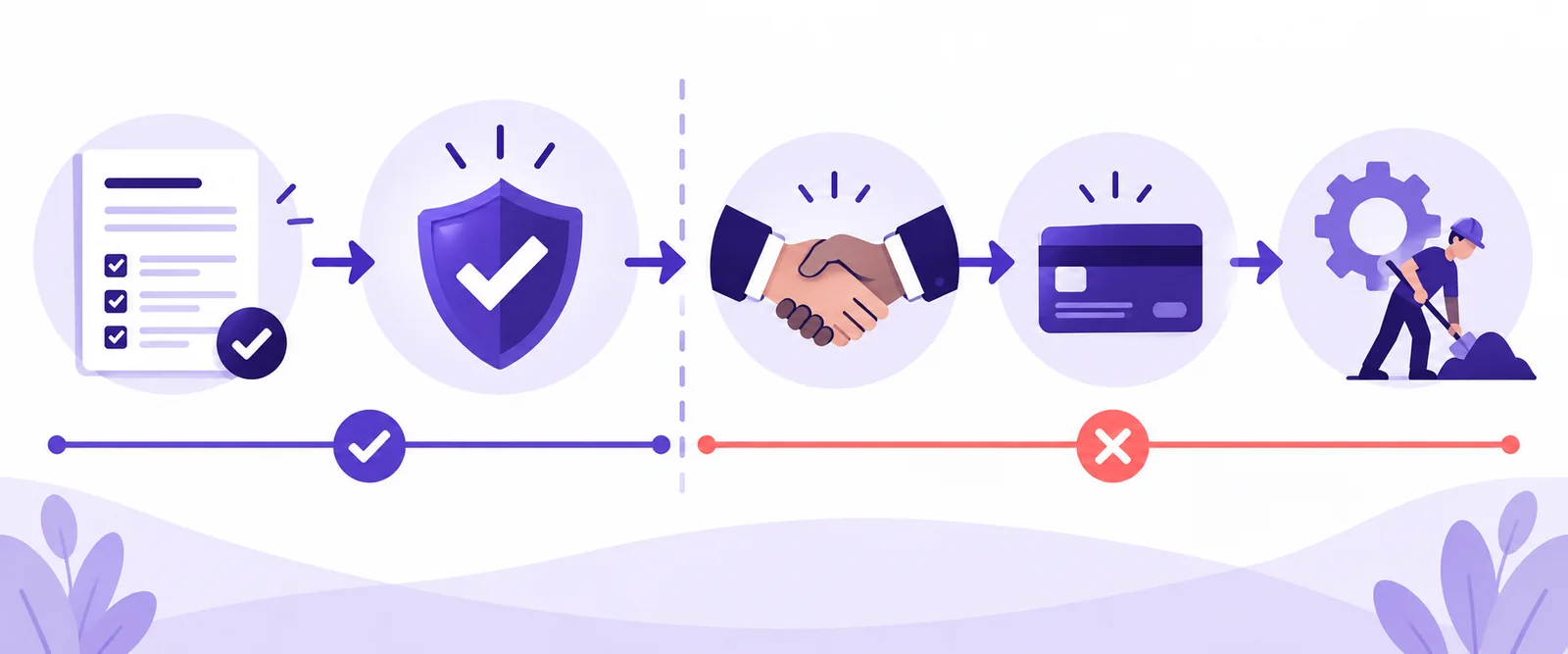
Retrospective applications are not supported. Enterprise Singapore treats an application as retrospective if the applicant has started work or made any payment or deposit to a supplier, vendor or third party before submitting the application.
After successful submission, a company may proceed before receiving approval, and qualifying costs incurred from the application date may be supported if the application is later approved. However, this is entirely at the company’s risk. Submission does not guarantee approval.
A safer operating rule is:
- confirm the correct EDGE activity;
- prepare the required proposal, quotation and supporting documents;
- submit through the Business Grants Portal;
- retain proof of submission; and
- avoid committing funds until approval unless the business can absorb the full cost if rejected.
How to apply for the EDGE Grant

1. Define the business outcome
Write down the problem, current baseline, desired improvement and how success will be measured. This makes it easier to select the right activity and compare vendors.
2. Find the relevant EDGE activity
Browse the official EDGE Grant directory or use the BizSG recommender. Check the activity’s supported costs, exclusions, eligibility, deliverables, duration and indicative processing time.
3. Check your company’s grant balance and activity rules
Confirm the remaining S$100,000 annual balance and, where relevant, the S$30,000 digitalisation/selected automation balance. Check whether the activity requires a pre-approved vendor, allows your own vendor or requires a certified consultant.
4. Prepare the documents
Requirements vary, but common items include a detailed vendor proposal and quotation, financial statements or management accounts, ACRA information, business-impact projections and evidence of the vendor’s qualifications. Build the application around deliverables you can prove at claim stage.
5. Submit through the Business Grants Portal
An authorised employee with the appropriate Corppass roles should submit the application. Vendors, service providers and other third parties are not allowed to apply, manage change requests or submit claims on behalf of the applicant company.
6. Review and accept the Letter of Offer
If approved, the Letter of Offer states the grant amount, conditions, project qualifying period and required deliverables. Read it carefully before execution. Enterprise Singapore says an approved vendor cannot simply be changed later; a company may need to terminate and submit a new application before proceeding with another vendor.
7. Complete, pay and claim
EDGE is reimbursement-based. Complete the approved work, achieve the deliverables, pay the eligible expenses and submit the claim with the required reports and proof of payment. The applicant company must apply, pay and claim.
Seven mistakes that can weaken an EDGE application

- Paying a deposit before submission. Even a small pre-application payment can make the application retrospective.
- Choosing a solution before defining the problem. Start with the business outcome and measurable baseline.
- Assuming the maximum rate applies. Funding percentages and caps differ by activity.
- Using the wrong vendor type. Some activities require pre-approved providers, SS 680-certified consultants or accredited testing and certification bodies.
- Submitting one application for several activities. EDGE generally requires one application per activity.
- Ignoring cash flow. The company must fund the project first and claim later.
- Underestimating evidence. Design the project so that deployed systems, training, reports, performance improvements and payments can be documented.
What happens to existing EDG, MRA and PSG applications?
Applications submitted before 30 September 2026 will continue to be assessed under the rules of the relevant legacy scheme. Approved and ongoing projects will continue through completion and claim disbursement.
No new EDG, MRA or PSG application is accepted after 29 September 2026. Companies that previously received support under those schemes may still apply for EDGE for a new project. They should not seek EDGE support for the same project or the same eligible expenses.
Previous utilisation under EDG, MRA and PSG does not count against the new EDGE annual cap. One significant transition point is that EDGE is not supportable under SkillsFuture Enterprise Credit (SFEC). For SFEC-supported programmes under EDG, MRA and PSG, Enterprise Singapore states that employers must submit final claims by 30 November 2026.
A practical 30-day preparation plan for SMEs

- Week 1—Diagnose: Identify one high-cost bottleneck, record the baseline and assign an internal project owner.
- Week 2—Match: Use BizSG and the official EDGE directory to shortlist the correct activity. Read every eligibility, exclusion and deliverable requirement.
- Week 3—Scope: Request detailed proposals that separate required features, implementation, training, milestones and cost items. Check vendor or consultant credentials.
- Week 4—Prepare: Gather financial and corporate documents, quantify expected business impact, confirm cash flow and submit before any work or payment begins.
Think beyond “Can we get a grant?” The better question is “Would this project still create a worthwhile business result if we had to pay the full cost?” A grant should improve the economics of a sound project, not rescue a weak one.
Frequently asked questions about the EDGE Grant
Is the EDGE Grant the same as the “H grant”?
The official name is the EDGE Grant. There is no newly launched Enterprise Singapore scheme officially called the “H grant” in the 30 September 2026 announcement.
What does EDGE stand for?
Nothing. Enterprise Singapore states that EDGE is not an acronym; the name signals the intention to help enterprises gain a competitive edge.
When did the EDGE Grant start?
It launched on 30 September 2026. EDG, MRA and PSG ceased accepting new applications after 29 September 2026.
What is the maximum EDGE Grant amount?
A company can receive up to S$100,000 across eligible EDGE activities in each grant year, which runs from 1 April to 31 March. Activity-specific caps still apply.
Can an SME receive 70% support?
Up to 70% support is available to SMEs for internationalisation and sustainability activities. Most other activities are supported at up to 50% for SMEs. The actual rate depends on the selected activity and assessment.
Can I apply for two EDGE projects at the same time?
Yes. Enterprise Singapore allows concurrent applications for different activities, with one application per activity and all approved support subject to the annual cap.
Can I use any vendor?
It depends on the activity. Some activities use pre-approved vendors, while others allow a company to propose its own vendor or consultant if the stated qualifications are met.
Can a grant consultant submit the application for my company?
No. EDGE applications, change requests and claims must be submitted by authorised personnel of the applicant company through the Business Grants Portal.
Can I start after applying but before approval?
You may proceed after successful submission, and eligible costs from the application date may be supported if approval is later granted. You bear the full risk if the application is rejected or costs are not approved.
Is EDGE paid upfront?
No. EDGE is reimbursement-based. The company completes the approved activity, pays the expenses and claims after meeting the required deliverables.
Does EDGE work with SkillsFuture Enterprise Credit?
No. Enterprise Singapore states that EDGE is not supportable under SFEC.
Turn a grant idea into a measurable project

If you are considering an AI, automation or digitalisation project, begin with the workflow and business case—not the grant form. GoalAxis can help you identify a practical starting point, clarify what should be automated and define the outcome before you compare solutions.
Request a free GoalAxis AI audit to find the bottleneck most worth solving first.